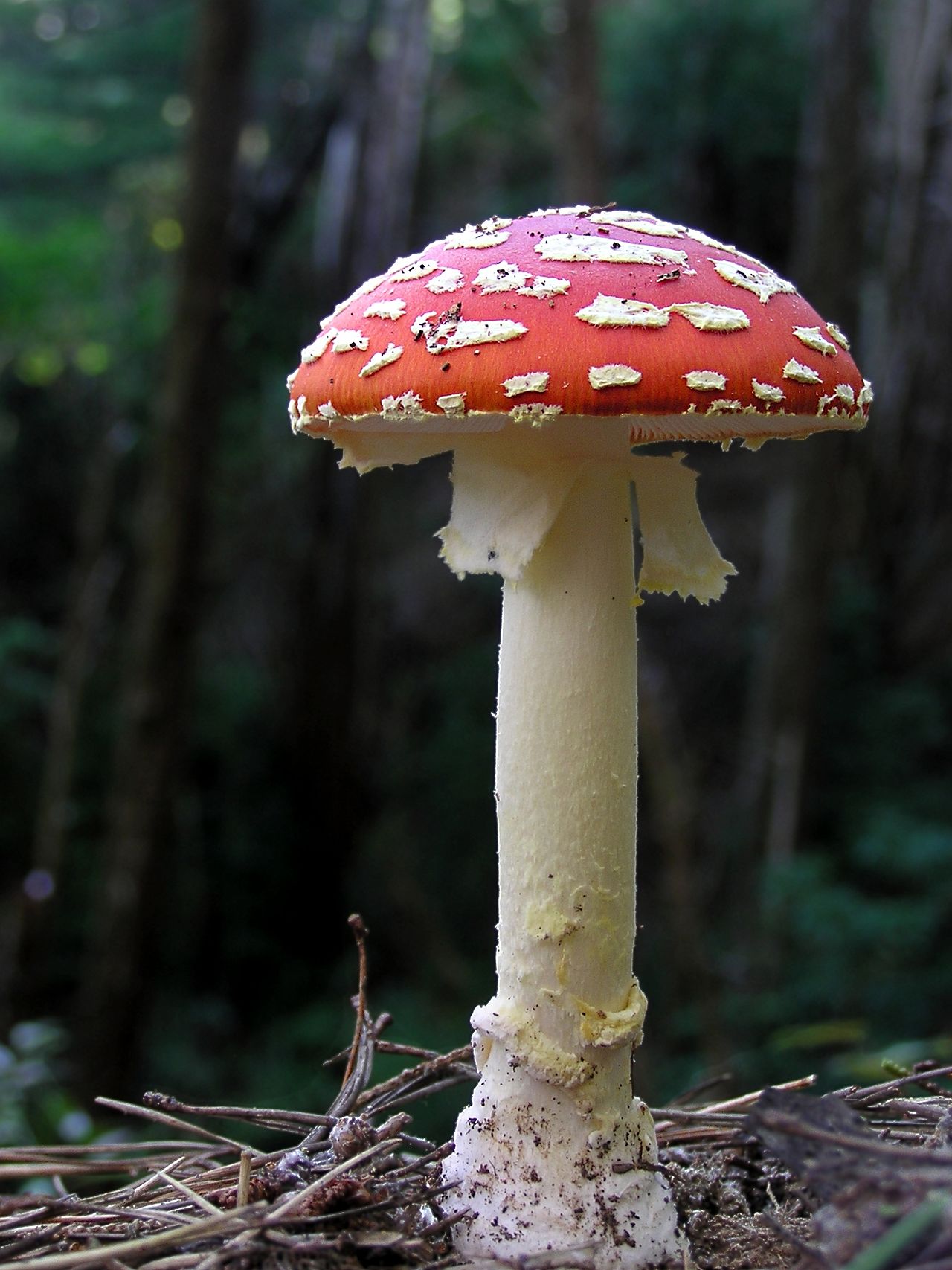
The name of the mushroom in many European languages is thought to derive from its use as an insecticide when sprinkled in milk. This practice has been recorded from Germanic- and Slavic-speaking parts of Europe, as well as the Vosges region and pockets elsewhere in France, and Romania. Albertus Magnus was the first to record it in his work De vegetabilibus some time before 1256, commenting vocatur fungus muscarum, eo quod in lacte pulverizatus interficit muscas, "it is called the fly mushroom because it is powdered in milk to kill flies."
The 16th-century Flemish botanist Carolus Clusius traced the practice of sprinkling it into milk to Frankfurt in Germany, while Carl Linnaeus, the "father of taxonomy", reported it from Småland in southern Sweden, where he had lived as a child. He described it in volume two of his Species Plantarum in 1753, giving it the name Agaricus muscarius, the specific epithet deriving from Latin musca meaning "fly". It gained its current name in 1783, when placed in the genus Amanita by Jean-Baptiste Lamarck, a name sanctioned in 1821 by the "father of mycology", Swedish naturalist Elias Magnus Fries. The starting date for all the mycota had been set by general agreement as January 1, 1821, the date of Fries's work, and so the full name was then Amanita muscaria (L.:Fr.) Hook. The 1987 edition of the International Code of Botanical Nomenclature changed the rules on the starting date and primary work for names of fungi, and names can now be considered valid as far back as May 1, 1753, the date of publication of Linnaeus's work. Hence, Linnaeus and Lamarck are now taken as the namers of Amanita muscaria (L.) Lam..
The English mycologist John Ramsbottom reported that Amanita muscaria was used for getting rid of bugs in England and Sweden, and bug agaric was an old alternative name for the species. French mycologist Pierre Bulliard reported having tried without success to replicate its fly-killing properties in his work Histoire des plantes vénéneuses et suspectes de la France (1784), and proposed a new binomial name Agaricus pseudo-aurantiacus because of this. One compound isolated from the fungus is 1,3-diolein (1,3-di(cis-9-octadecenoyl)glycerol), which attracts insects. It has been hypothesised that the flies intentionally seek out the fly agaric for its intoxicating properties. An alternative derivation proposes that the term fly- refers not to insects as such but rather the delirium resulting from consumption of the fungus. This is based on the medieval belief that flies could enter a person's head and cause mental illness. Several regional names appear to be linked with this connotation, meaning the "mad" or "fool's" version of the highly regarded edible mushroom Amanita caesarea. Hence there is oriol foll "mad oriol" in Catalan, mujolo folo from Toulouse, concourlo fouolo from the Aveyron department in Southern France, ovolo matto from Trentino in Italy. A local dialect name in Fribourg in Switzerland is tsapi de diablhou, which translates as "Devil's hat".